Explainer
An electron is a negatively charged subatomic particle. A proton has positive charge, and a neutron has no net electric charge. Understanding where these particles are, and what their charges mean, helps connect the structure of matter to the electricity used in a computer.
Inside the atom
Protons and neutrons are found together in the nucleus. Electrons occupy quantum states associated with the region around it, often pictured as an electron cloud. That picture describes a probability distribution, rather than a collection of miniature planets following fixed circular roads.
Protons and neutrons sit together in the nucleus, as the diagram in the video shows. The number of protons determines the element, rather than its atomic weight. Changing the number of neutrons gives different isotopes of that element, while gaining or losing electrons changes an atom’s electric charge.

Charge, mass and identity
A neutral atom has the same number of electrons and protons. Losing an electron leaves a positive ion; gaining an electron creates a negative ion. The nucleus accounts for nearly all of an atom’s mass, while electrons are central to chemical bonding and electrical behavior.
OpenStax’s introduction to atomic structure separates atomic number, mass number and electric charge. These quantities answer different questions. Keeping them separate makes the atom much easier to understand than asking one city metaphor to explain everything.
How electrons relate to electricity
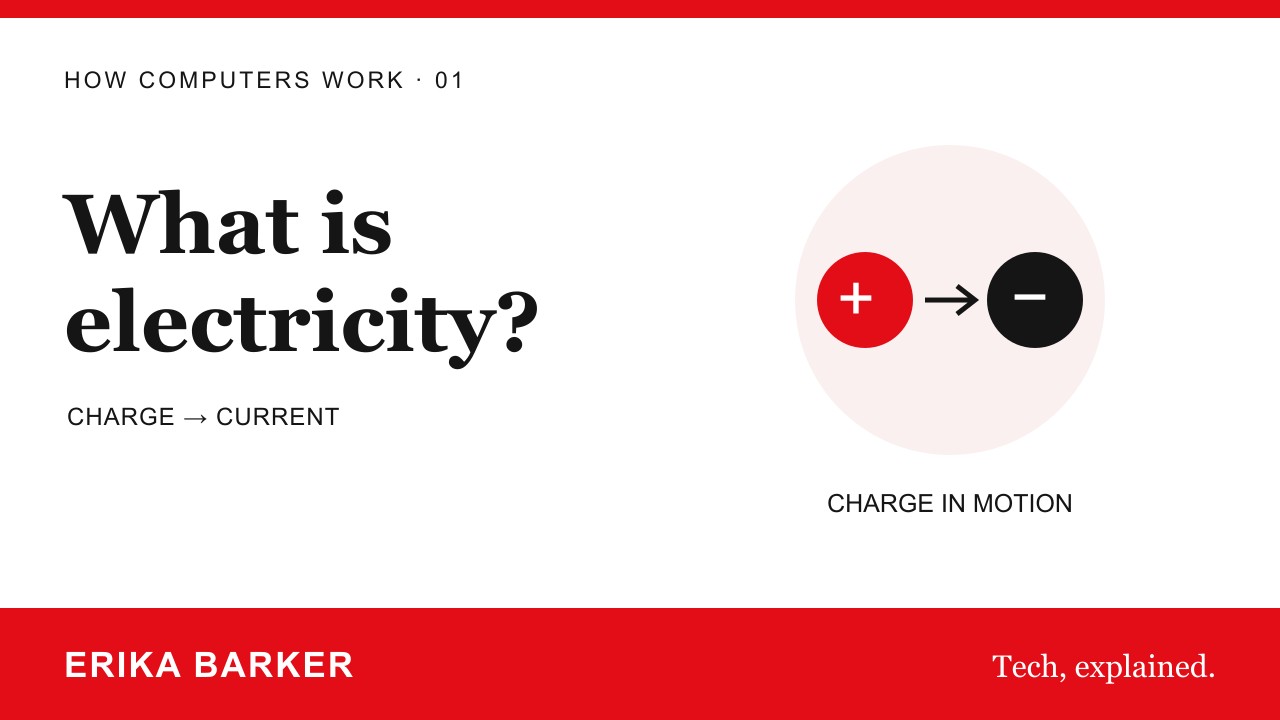
In a metal conductor, electrons can carry an electric current. During discharge, a battery can drive electrons through an external circuit from its negative terminal toward its positive terminal. Conventional current is defined in the direction positive charge would move, so it points the opposite way to electron drift in that metal wire.
Other materials can have different charge carriers, including ions in liquids. Electricity therefore includes more than electrons passing from one atom to the next. OpenStax’s chapter on current explains this distinction and the role of the electric field.
Continue the series
Return to electric charge and current if you want to connect the particles to a circuit. Continue to how binary code works to see how physical hardware can represent information. The complete series keeps the three lessons together.
Transcript
Read the original video transcript
The anatomy of an atom. It's the basic building block of all matter, but do we really know what goes on in there? Well, let's break it down.
Think of an atom as a tiny city. At the center of the city is the nucleus, and this is where you'll find the real power players: the protons. These particles have a positive charge and a significant weight - they give the atom its atomic weight, which determines what type of element it is. For instance, it could be cobalt or iron.
Now, let's head to the outskirts of the city, where the streets are a bit quieter. Here, we find the neutrons, and they're the heavyweights of the city. They don't carry any charge, but they play an important role in balancing out the protons and keeping the nucleus from falling apart.
Finally, we come to the suburbs - the electron shells. Here, you'll find the electrons, and they are a completely different type of particle. They have a negative charge, are light, and are constantly moving around the nucleus, like kids on a playground. Their main function is to participate in chemical reactions and bond with other atoms. Simply put, they determine whether to bond with another atom to form a molecule or not.
Regarding electricity, an electric current is created when electrons flow from one atom to another. For instance, in a battery, electrons flow from the negative electrode to the positive electrode, generating an electric current that can be used to power a device. Imagine electrons as water in a lake, and if an earthquake creates a canyon causing the water to rush through as a fast-moving current, this can be thought of as electricity.
In conclusion, there is a difference between protons, neutrons, and electrons in an atom. The atom acts like a tiny city with its own government, citizens, and visitors, all working together to make up the building blocks of the universe. While we may not yet fully understand what goes on inside the nucleus, we can still appreciate the mysteries of the atom.