Explainer
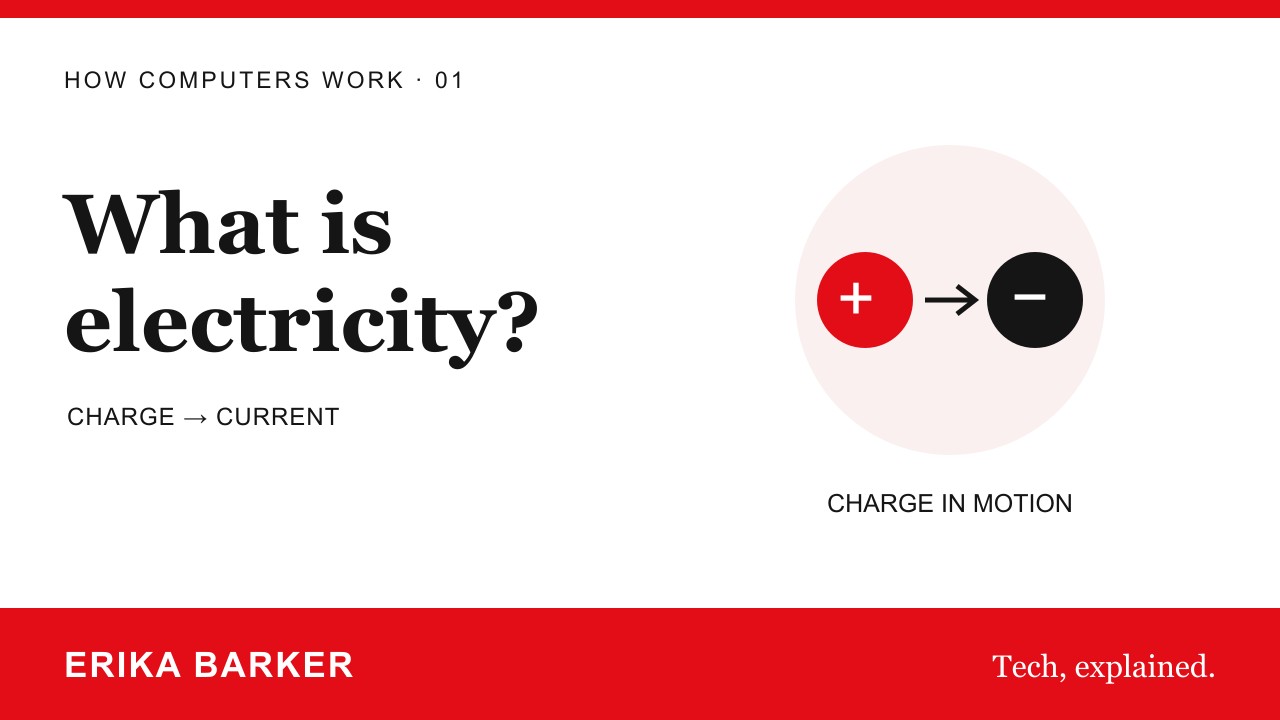
Ohm’s law connects three quantities that turn up throughout electronics: voltage, current and resistance. If you know two of them for an ohmic component, the relationship lets you calculate the third. My video uses water moving through a pipe to introduce the idea, then works through a numerical example.
What does V = IR mean?
Voltage, written V, is electric potential difference, measured in volts. Current, written I, measures how quickly electric charge passes a point and is measured in amperes, usually shortened to amps. Resistance, written R, describes the opposition to current and is measured in ohms, written Ω.
The equation is V = I × R. Rearranging it gives I = V / R when you want the current, or R = V / I when you want the resistance. The water analogy helps us picture pressure and flow, but the electrical quantities have their own precise definitions.
A worked example: 120 volts and 10 ohms
In the example from the recording, the voltage is 120 V and the resistance is 10 Ω. Dividing 120 by 10 gives a current of 12 A. You can check the calculation by multiplying the current and resistance: 12 A × 10 Ω returns the original 120 V.
Where the relationship applies
The constant-resistance version applies to an ohmic component under the conditions being considered. It is not a universal description of every electronic device, because components such as diodes can have nonlinear current-voltage behavior. Temperature and operating conditions can also change a component’s resistance, so the number on paper needs to describe the situation you are actually analyzing.
For further reading, OpenStax explains Ohm’s law and the distinction between ohmic and nonohmic materials. Start with electric charge and current if the quantities still feel abstract. Then follow the computing and electronics lessons to connect physical circuits with digital information.
Transcript
Read the original video transcript
Ohm's Law, the electrical equation that rules them all. When it comes to understanding electricity, there's one equation that reigns supreme. Ohm's Law. This simple formula is the cornerstone of electrical engineering, and it is essential for anyone who wants to get a grip on how electricity works. But what exactly is Ohm's law? Simply put, it's an equation that relates the flow of electricity, amperage, the pressure behind the flow, voltage, and the resistance in the circuit.
And the equation is voltage equals current times resistance. Or V equals IR, where V is voltage, I is amperage, and R is resistance. So think of it this way. Imagine you're trying to push water through a pipe. The flow of the water is like amperage, the pressure behind the water is like voltage, and the size of the pipe is like resistance. Ohmslaw says that if you know two of these things, you can actually figure out the third. For example, let's say that you have a
circuit that has 120 volts of pressure and 10 ohms of resistance. According to Ohm's law, the amperage in the circuit would be 12 amps. Voltage divided by resistance equals current or amperage. So the equation tells us that if we know the voltage and resistance in a circuit, we can calculate the amperage. But why is this important? Well, Ohm's law is the key to understanding how electricity behaves in different circuits. It helps us predict what will happen
when we change the voltage, resistance, or amperage in a circuit. This knowledge is essential for electrical engineers who use Ohm's law to design and build everything from tiny electronic devices to massive power grids. So the next time you're dealing with electricity, remember Ohm's law, It might seem like a simple equation, but it holds the key to understanding the flow and behavior of electrical energy. With Ohm's Law in your back pocket, you'll be able to conquer even the most complex electrical problems.