Explainer
Electricity is a name for phenomena involving electric charge, including charges at rest and charges in motion. The shock from a doorknob and the current in a circuit belong to that same subject, but they describe different situations. A balloon and a few strands of hair give us a useful place to start.
Why does a balloon attract your hair?
Rub a balloon against your hair and electrons can transfer between the two materials. In the familiar example, the balloon gains electrons and becomes negatively charged, while the hair loses electrons and becomes positively charged. The opposite charges attract, so your hair follows the balloon instead of your instructions.
Rubbing transfers charge; it does not manufacture it. The amount and direction of transfer depend on the materials and conditions. OpenStax explains this process in its chapter on static electricity and conservation of charge.
Static electricity and current are different ideas
Static electricity concerns an imbalance or distribution of charge that can persist on an object. Electric current measures the rate at which charge passes a point. A brief discharge from your finger to a doorknob is a current, even though we usually describe the experience as a static shock.
Electrons carry current in metal wires, but electricity is broader than moving electrons. Positive and negative ions can carry current in a liquid, for example. That distinction matters when an explanation moves from a copper wire to a battery or a biological system, as OpenStax’s introduction to electric current describes.
Where voltage fits
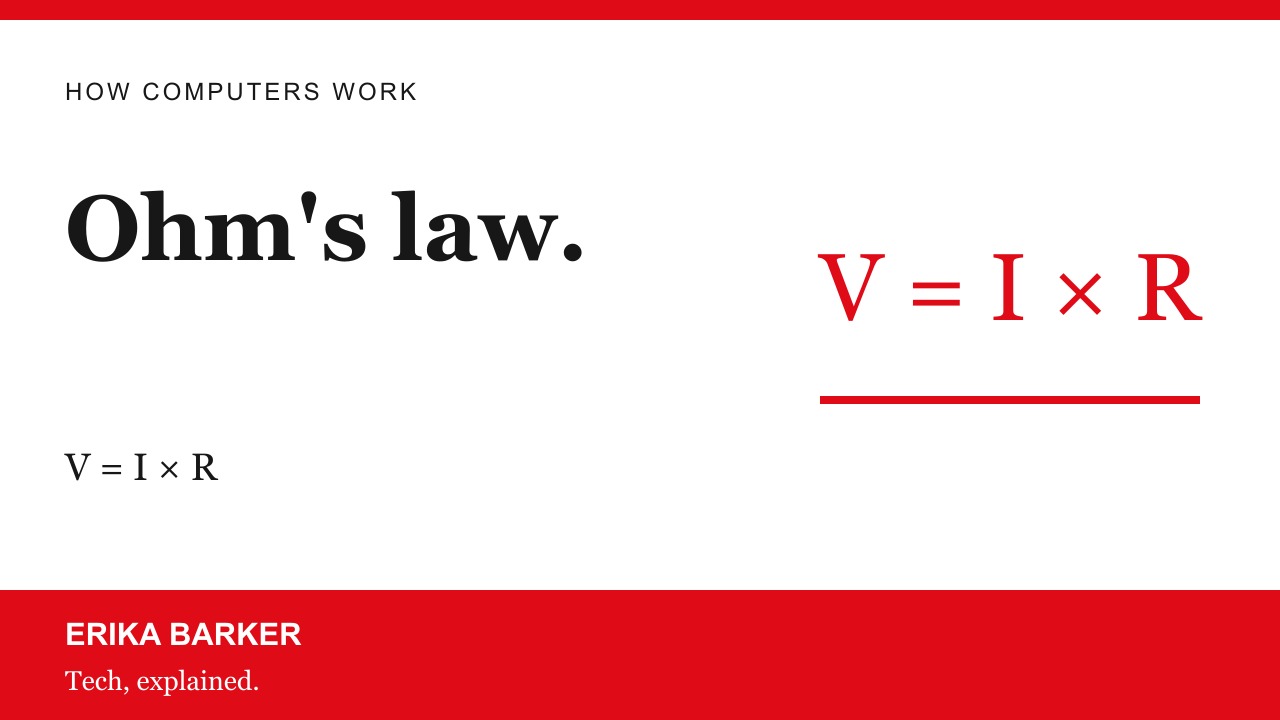
Voltage is electric potential difference: energy per unit charge. In a simple circuit, a battery maintains a potential difference, and the electric field exerts forces on charges in the conducting path. Current tells us how quickly charge passes; voltage tells us about the energy change per unit charge.
The plumbing analogy in my video gives us a starting picture of a circuit. Its limits matter, too: electrical behavior involves fields, and an individual electron does not have to travel from the battery to a lamp before the lamp responds. Read Ohm’s law and simple circuits for the relationship between voltage, current and resistance in the simple resistive case.
Continue the series
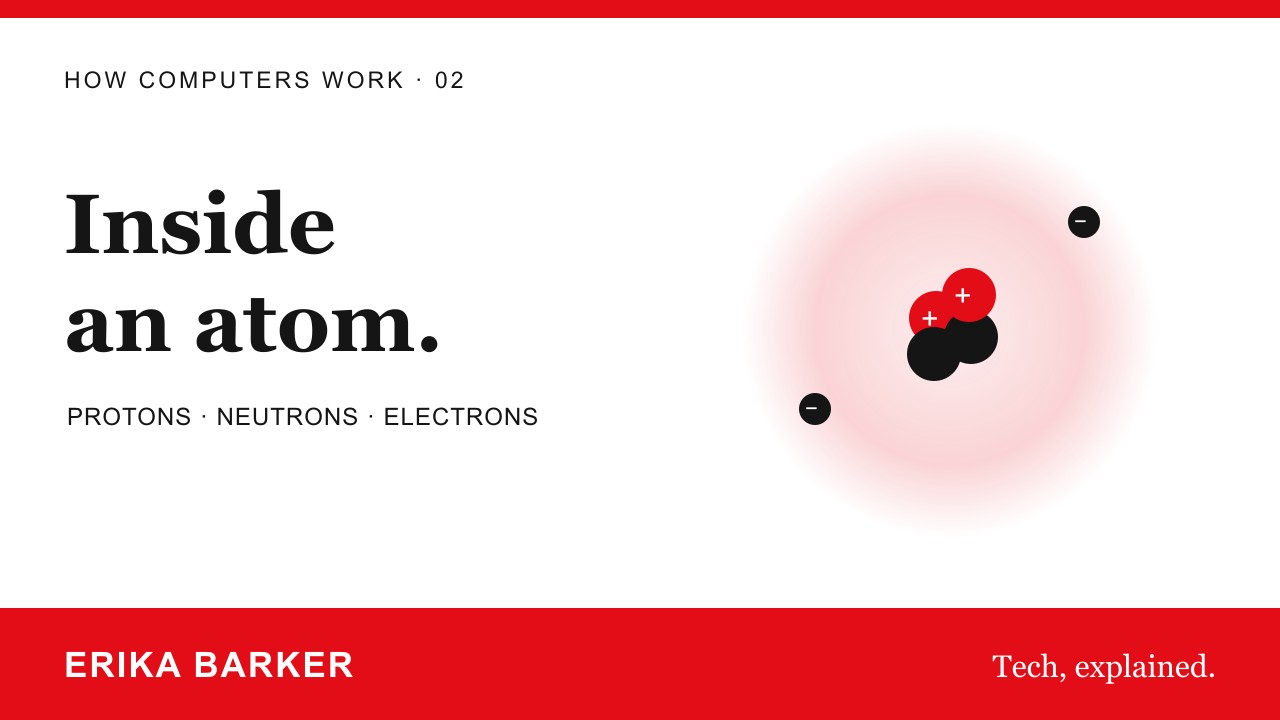
The next lesson looks inside the atom at electrons, protons and neutrons. Those particles help explain electrical charge, but a computer also needs a convention for representing information. The third lesson follows that step into binary numbers and text.
Transcript
Read the original video transcript
Imagine you're on a journey, traveling deep into the unknown territories of the electric universe. You've got your backpack filled with a curious mind and a thirst for knowledge, ready to explore the mysteries of electrical charge. So as you're walking along, you come across a strange phenomenon: you touch a doorknob after shuffling across the carpet on a dry day, and suddenly you feel a jolt of energy run through your body. You've just felt the power of electrical charge, and it's time to take a closer look to see what's going on.
So really quick, long ago, brave explorers of the electric world discovered that when they rubbed certain objects together, it would cause those objects to either attract or repel. It was like a magical dance between two partners, one pulling and the other pushing. But what was the cause of this strange dance?
So as you know by now, atoms are like the tiny building blocks. They're too small for the human eye to see, and within each atom there are three even tinier particles: protons, neutrons and electrons. Now, protons and electrons are like positive and negative magnets, attracting and repelling each other. Neutrons, on the other hand, are neutral, like a still rock in the middle of a raging river.
Now, for an example here, when you rub a rubber balloon on your hair, the friction creates an imbalance of electrical charges between those objects. The rubber material has a stronger desire for electrons than your hair, so the balloon steals some of those negatively charged electrons from your locks. Now there are more electrons than usual on the balloon, so it's negatively charged, while your hair has an overall positive charge.
Now this movement of electrons from one place to another is what we call electricity. And just like a river that flows from its source to the sea, electrons move from one place to another, bringing energy and life to the electric world. Now, electrical engineers, they're kind of like a plumber of the electric world. Instead of using pipes and valves to direct the flow of water, they design electronic circuits to control the movement of electrons, to put them in the right place at the right time to do something useful, like your light.
So, my friends, join me on this journey into the unknown territories of the electric universe, where the mysteries of electrical charge wait to be explored and uncovered.