
Watch & learn · Erika Barker
From the electron
to the app.
A computer is physical before it is digital. This learning path starts with charge and circuits, then follows the components that become switches, logic and processors. From there, we reach operating systems, networks and the devices that run software in the world.
Watch the playlist on YouTube ↗Part 1
Charge & circuits
2 min 24 sec
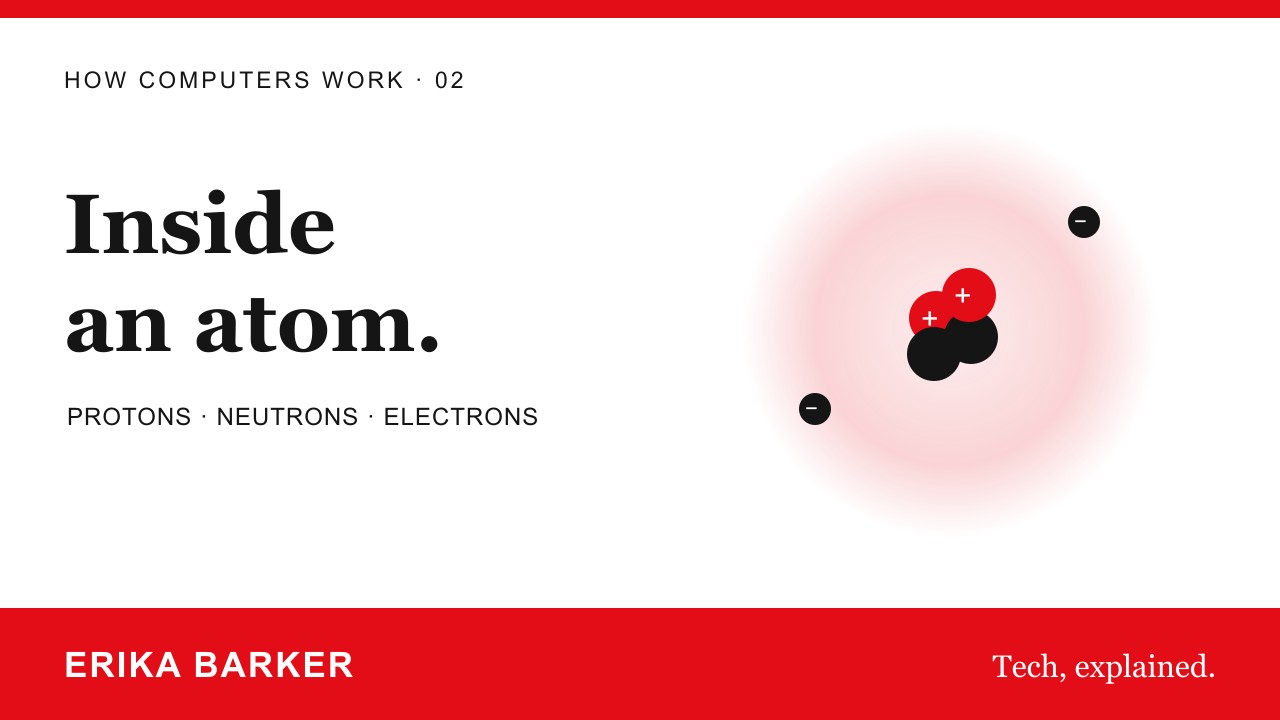
Electrons, Protons and Neutrons: Inside an Atom
Learn where electrons, protons and neutrons are found, what determines an element, and how moving charge relates to electricity. Video and explanation by Erika Barker.
Watch, read & explore ↗2 min 32 sec
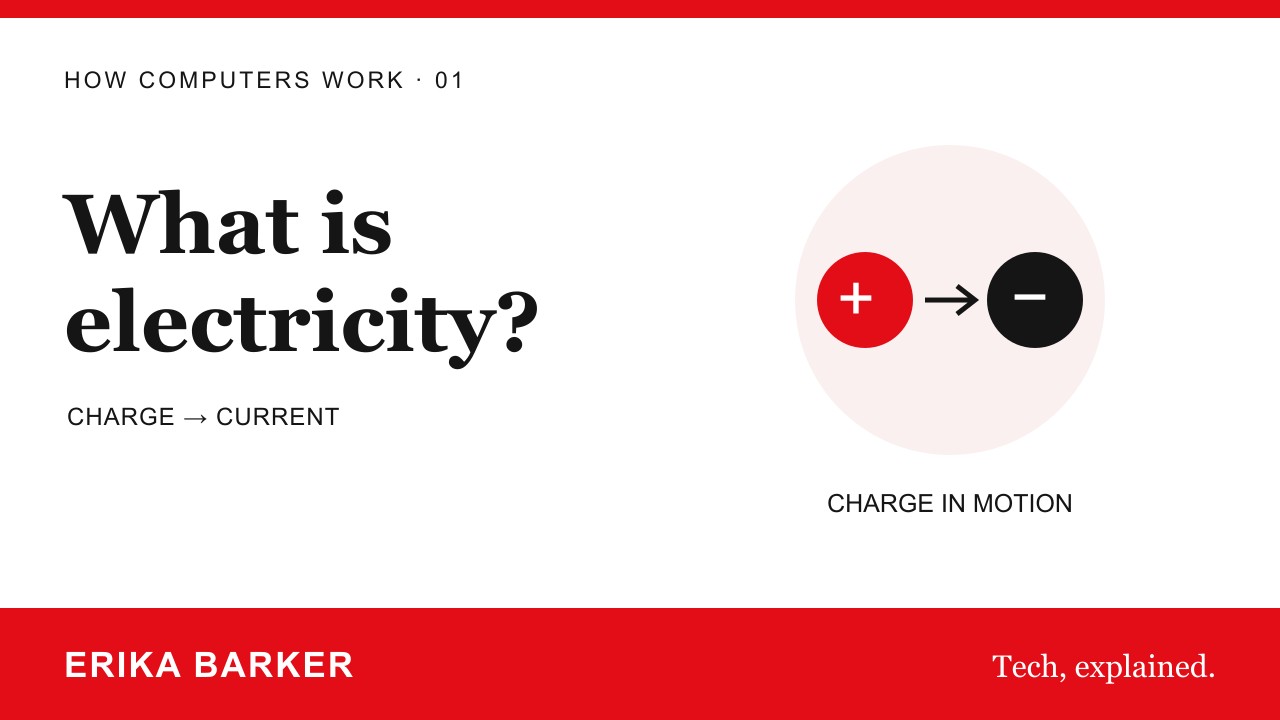
What Is Electricity? Charge and Current Explained
Why a balloon attracts your hair, what electric charge means, and how static electricity differs from current. A video lesson and explanation by Erika Barker.
Watch, read & explore ↗2 min 19 sec
Conductors and Insulators: Why Rubber Resists Current
Some materials let electric charge move easily, while others strongly resist that movement. Metals have mobile electrons, whereas an ordinary insulator has very few charges available to carry current under normal conditions. That distinction helps explain why wires use a conducting core and an insulating covering.
Watch, read & explore ↗2 min 18 sec
How Electrical Circuits Work: Source, Path and Load
A simple circuit connects an energy source to a load through a complete electrical path. The load might be a lamp, a motor or another device that turns electrical energy into something useful. Voltage, current and resistance describe what happens in that path, while power tells us how quickly energy is transferred.
Watch, read & explore ↗2 min 20 sec
Volts vs Amps: What Is the Difference?
Voltage and current describe different parts of an electrical circuit. Voltage tells us how much energy is available per unit charge, while current tells us how much charge passes a point each second. Thinking about water pressure and flow gives us a starting point for understanding how a circuit supplies power.
Watch, read & explore ↗2 min 22 sec
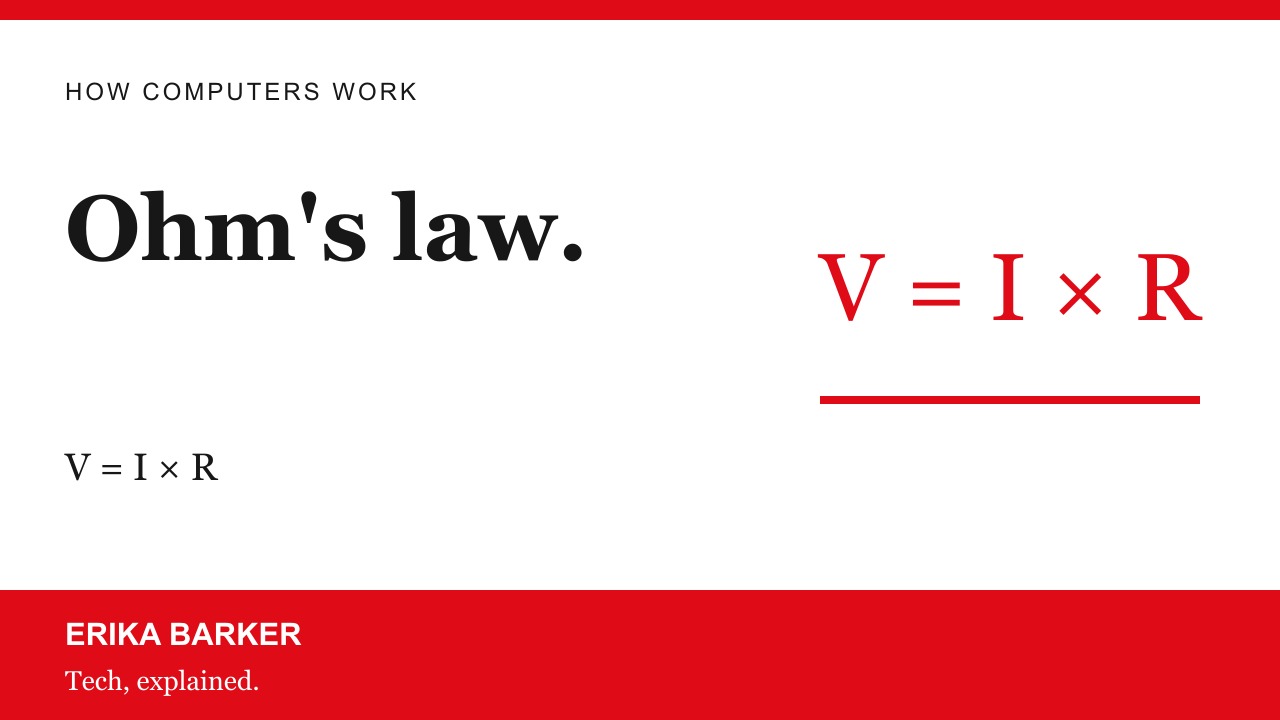
Ohm's Law Explained: Voltage, Current and Resistance
How voltage, current and resistance connect through Ohm's law, with a worked 120 V and 10 ohm example. Watch Erika Barker's lesson and read the transcript.
Watch, read & explore ↗3 min 24 sec
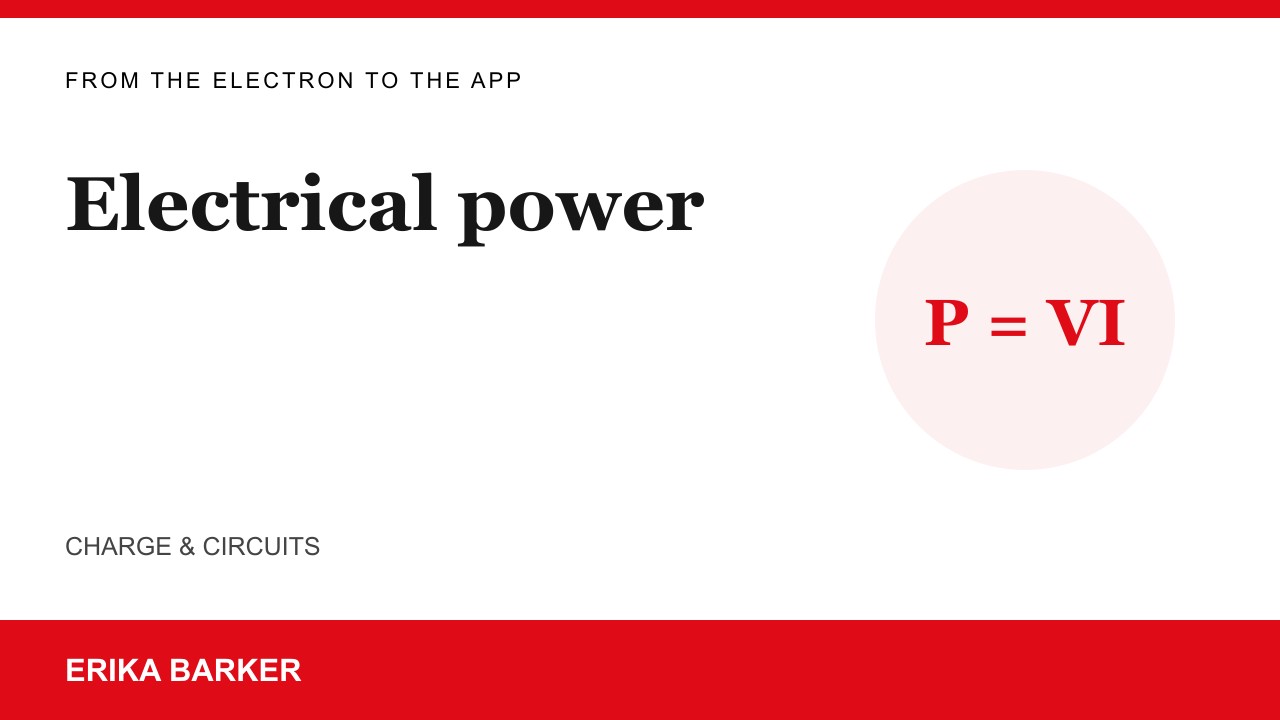
Electrical Power Explained: Watts, Volts and Amps
Electrical power tells us how quickly energy is transferred. In a DC circuit, multiplying voltage by current gives power in watts. Combining that relationship with Ohm’s law helps explain both useful power at a load and heat dissipated in resistance.
Watch, read & explore ↗1 min 19 sec
AC vs DC: Alternating and Direct Current Explained
Alternating current reverses direction, while direct current keeps flowing in one direction. Homes commonly receive AC, and many electronic devices convert that supply into DC internally. Diodes help with that conversion by allowing current to pass much more easily in one direction than the other.
Watch, read & explore ↗3 min 54 sec
What Is Frequency? Hertz, Waves and AC Electricity
Frequency describes how often a repeating event completes a cycle. One hertz means one cycle per second, whether we are talking about a wave, an electrical signal or a clock. That idea connects sound and alternating current to the timing signals used in digital electronics.
Watch, read & explore ↗3 min 9 sec
Electromagnetism Explained: Electricity and Magnetism
Electricity and magnetism are connected parts of the same physical interaction. A current creates a magnetic field, and changing magnetic flux can produce an induced voltage. Those relationships are behind the motors, generators and transformers that turn electrical ideas into useful machines.
Watch, read & explore ↗
Part 2
Components & switches
2 min 18 sec
How Resistors Work: Resistance and Heat
A resistor gives us a way to control current in a circuit. For the same applied voltage, a larger resistance allows less current to flow and turns electrical energy into heat. That makes resistors useful for setting operating conditions and protecting components from excessive current.
Watch, read & explore ↗1 min 44 sec
How Potentiometers Work: The Electronics Behind a Volume Knob
A potentiometer turns a physical movement into an adjustable electrical value. Its wiper slides along a resistive track, changing the resistance between the wiper and either end. Connect the ends across a supply and the wiper gives you an adjustable fraction of that voltage.
Watch, read & explore ↗1 min 24 sec
Batteries vs Capacitors: How They Store Energy
Batteries and capacitors both store energy, but they store it in different ways. A battery uses chemical reactions, while an ordinary capacitor stores energy in an electric field between separated charges. That difference makes capacitors useful for quick bursts and filtering, while batteries commonly supply energy over longer periods.
Watch, read & explore ↗1 min 34 sec
How Capacitors Work: Electric Fields and Quick Energy Storage
A capacitor stores energy in an electric field between separated charges. Its conductive surfaces are separated by an insulating dielectric, which lets it hold that separation without a direct conducting path between the plates. A circuit can use that stored energy for a brief burst, or use the capacitor to help filter changing signals.
Watch, read & explore ↗2 min 29 sec
How Inductors Work: Coils, Magnetic Fields and Stored Energy
An inductor stores energy in a magnetic field when current flows through it. It opposes changes in that current, which is why a coil can produce a voltage spike when a circuit switches off. That behavior makes inductors useful in power supplies, filters and magnetic devices.
Watch, read & explore ↗2 min 54 sec
How Diodes Work: Rectifiers and One-Way Current
A diode acts roughly like a one-way valve for electrical current. That makes it useful for rectifying AC, steering signals and protecting parts of a circuit when the right device is selected. Different diode types also let us regulate voltage or produce light.
Watch, read & explore ↗1 min 58 sec
How Transistors Work: Electronic Switches and Amplifiers
A transistor lets one electrical signal control another current. It can act as a switch or operate as an amplifier, depending on how the circuit uses it. Put many transistors together and those small controlled actions become the logic and signal processing inside modern devices.
Watch, read & explore ↗2 min 28 sec
How Amplifiers Work: From Microphones to Camera Sensors
An amplifier lets a small signal control a stronger output. The extra energy comes from a power supply, not from creating energy inside the input signal. That is how a microphone signal can help drive a speaker or a small sensor signal can become easier to process.
Watch, read & explore ↗2 min 17 sec
Buttons vs Switches: How They Control a Circuit
A switch controls a circuit by making or breaking an electrical connection. A common push button makes that connection only while you hold it, while a maintained switch stays where you put it. Those simple actions give a device a way to respond when you press, flip or release a control.
Watch, read & explore ↗1 min 53 sec
How Breadboards Work: Prototyping Circuits Without Solder
A breadboard lets you connect components without soldering them together. Metal contacts beneath the holes join selected rows and power rails, so where you place a wire matters. You can move parts around, test an idea and then transfer a working circuit to a permanent board.
Watch, read & explore ↗2 min 21 sec
How Voltage Dividers Work: Resistors and Output Voltage
A voltage divider uses resistors to produce a fraction of an input voltage. The output comes from the junction between the resistors, and their relative values determine the unloaded ratio. Connecting a load changes the circuit, which is why a divider is useful for many measurements but is not a general power regulator.
Watch, read & explore ↗
Part 3
Bits & processors
4 min 23 sec
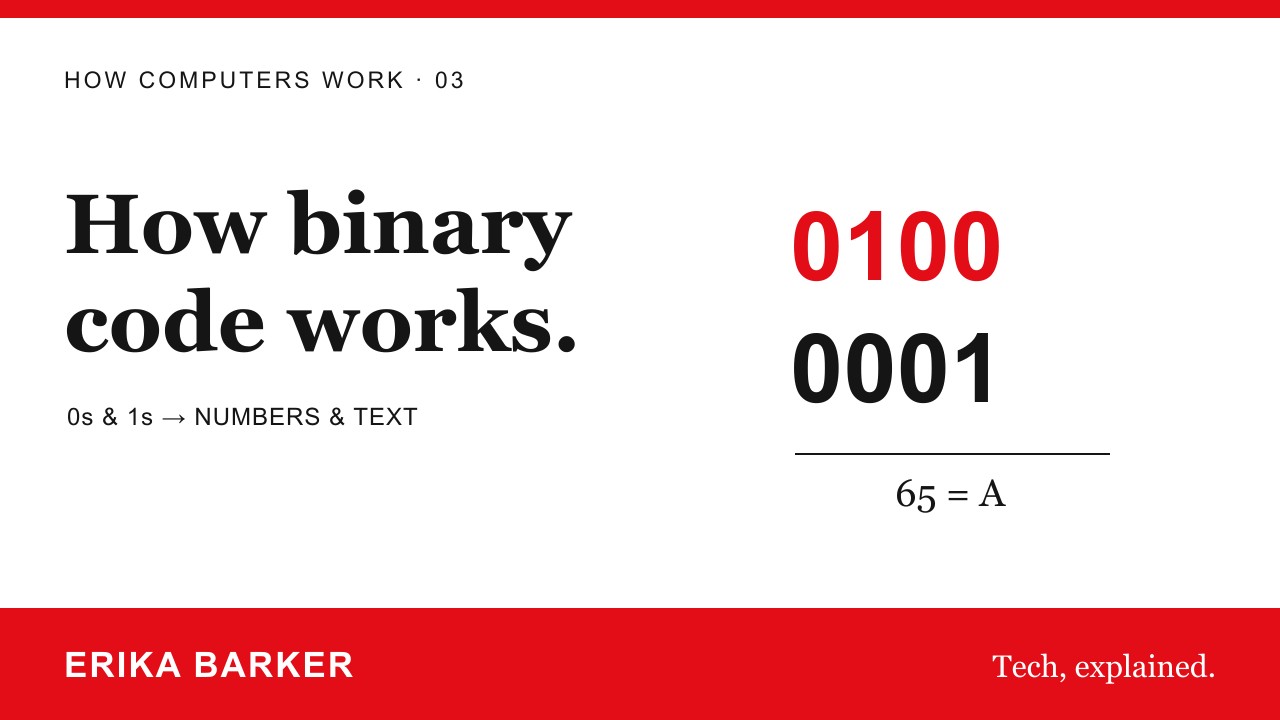
How Binary Code Works: 0s, 1s, Numbers and Text
How do computers use 0s and 1s? Learn binary numbers, bits, ASCII and text encoding with Erika Barker’s video, worked examples and transcript.
Watch, read & explore ↗7 min 14 sec
Boolean Logic Explained: AND, OR and NOT Gates
A computer can turn simple true-or-false decisions into much more complicated behavior. AND requires both inputs to be true, OR requires at least one and NOT reverses the input. Combining those operations gives us the logic circuits behind processors, memory and everyday digital devices.
Watch, read & explore ↗2 min 15 sec
How Billions of Transistors Fit Inside a CPU
Chip manufacturing repeats extremely small patterns across a silicon wafer. Lithography helps define those patterns, and many fabrication steps build transistors and the connections between them layer by layer. The wafer is then cut into individual dies that can be packaged and connected to the rest of a device.
Watch, read & explore ↗2 min 10 sec
How Microcontrollers Work: Processor, Memory and Input-Output
A microcontroller puts a processor, memory and input and output connections on one chip. Its program reads information from the outside world and decides what the device should do next. That small package is what lets a washing machine, a traffic light or a robot respond to what is happening around it.
Watch, read & explore ↗0 min 59 sec
What Is CISC? CPU Instructions and Computing History
An instruction set defines the operations software can ask a processor to perform. CISC designs include instructions that can express relatively complex work, and a processor may implement some of them through smaller internal operations or microcode. The instruction seen by a programmer and the work performed inside the chip are related, but they are not the same layer.
Watch, read & explore ↗0 min 59 sec
GPUs vs CPUs for AI: Parallel Computing Explained
CPUs and GPUs are designed around different kinds of work. A CPU handles a broad mix of tasks, while a GPU can apply similar operations to many pieces of data at once. That makes GPUs useful for many deep-learning calculations, including matrix multiplication, when the workload is large enough to benefit.
Watch, read & explore ↗
Part 4
Software & networks
0 min 59 sec
A Short History of Linux, GNU and the Linux Kernel
Linux is the kernel that manages core interactions between software and hardware. Many complete operating systems combine it with GNU tools and other software developed by a wider community. That distinction helps explain how one kernel became the foundation for many different systems.
Watch, read & explore ↗0 min 59 sec
How TCP and IP Work: Packets and the Internet
Internet communication relies on several protocols working together. IP helps packets reach their destination, while TCP can provide an ordered, reliable stream of data between applications. The receiving application then decides what those bytes mean, whether they represent a page, a message or part of a video.
Watch, read & explore ↗0 min 59 sec
What Is Oblivious DNS over HTTPS? Internet Privacy Explained
DNS helps a browser find the address associated with a website name. Oblivious DNS over HTTPS adds a proxy and encryption so that the proxy and resolver each see only part of the lookup. That separation improves privacy when the services do not combine their knowledge, but it does not make every part of browsing anonymous.
Watch, read & explore ↗0 min 58 sec
What Is Edge Computing? Processing Data Closer to Its Source
Edge computing moves some processing closer to where data is created. A device can handle a local task before sending information to a distant server, which can reduce delay and network traffic. The useful question is which work belongs nearby and which work still benefits from the cloud.
Watch, read & explore ↗0 min 59 sec
What Is the Internet of Things? Connected Devices and Sensors
The Internet of Things connects physical devices so they can collect information, exchange it and act on it. Sensors give those systems a way to notice temperature, movement, sound and other conditions in the real world. The useful result depends on what the system does with that information, from adjusting a room to helping manage a factory.
Watch, read & explore ↗0 min 59 sec
What Is TinyML? Machine Learning on Small Devices
TinyML brings small machine-learning models to devices with tight memory and power limits. A local model can detect a pattern, such as a wake word, without sending every sample to a distant server. The device can then act on that result or send selected information onward when the application needs it.
Watch, read & explore ↗


From foundations to research
Binary tells us how information can be represented. Data science asks what that information means, how it was collected, and what conclusions it can support. Explore Tech & AI, data science, or my current research and projects when you are ready to follow that thread.