Explainer
Electrical power tells us how quickly energy is transferred. In a DC circuit, multiplying voltage by current gives power in watts. Combining that relationship with Ohm’s law helps explain both useful power at a load and heat dissipated in resistance.
The key ideas
- Power is energy transferred per second.
- For DC, P = VI.
- What stays constant matters when comparing resistor heating.
Explore the subject
- nist.gov technical reference 1
- sparkfuneducation.com technical reference 2
- nvlpubs.nist.gov technical reference 3
Original recording: TikTok, 2023-02-18.
Video transcript
Read the original recording’s transcript
Automatically transcribed from the original recording. Small transcription errors may remain.
Ah, Watt's Law. It's a fundamental concept that underpins much of electrical engineering. But before we dive into the details, let's take a quick look at the history of Watt's Law. So it's named after James Watt, a Scottish inventor and engineer who is widely regarded as the father of the modern steam engine. So Watt is credited with many important innovations in the field of power generation and machinery, including the Watt steam engine, which was a major contributor to the Industrial Revolution. It was during his work on the steam engine that Watt first discovered the relationship between power, voltage, and current that we know of today as Watt's law.
So what exactly is Watt's law and how does it work? Well, simply put, Watts' law is a mathematical formula that describes the relationship between power, voltage, and current in an electrical circuit. So the formula is P equals V times I, where P is power, V is voltage, and I is current. So let's break that down a little further. So power is a measure of the rate of which energy is being transferred, and it's usually measured in watts. Voltage is a measure of the electrical potential difference between two points in a circuit, and it's usually measured in volts.
Current is a measure of the flow of electrical charge through a circuit, and it's usually measured in amps. Now, what Watts' law tells us is that the amount of power being delivered by a circuit is directly proportional to the voltage and current in that circuit. So in other words, if you increase the voltage or the current, you will also increase the amount of power being delivered. This is why high voltage power lines can carry so much power than a low voltage line. The higher voltage allows for a greater amount of power to be transferred. But it's not just about increasing the voltage or the current.
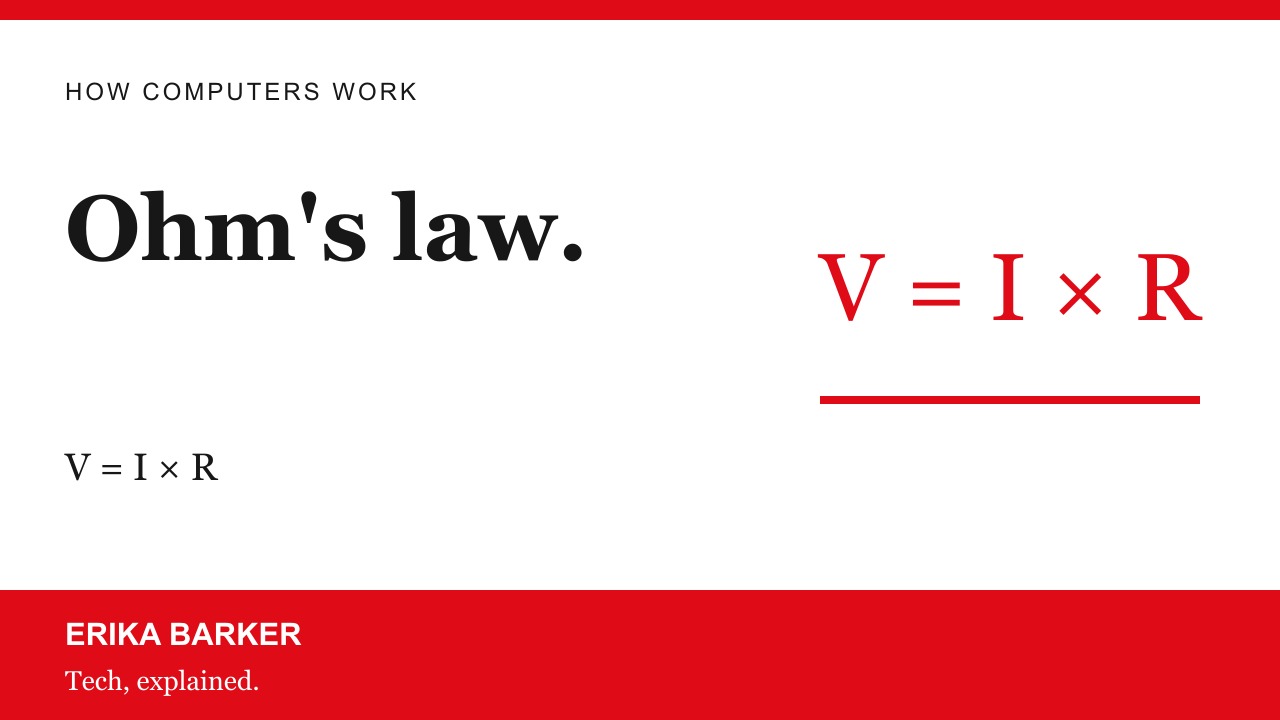
You also need to consider the resistance of the circuit. Resistance is a measure of how much a circuit impedes the flow of current. That's usually measured in ohms. The higher the resistance, the more power will be lost as heat, which means less power is available to do useful work. And that's where Ohm's Law comes in. Ohm's Law is another important electrical principle that describes the relationship between voltage, current and resistance in a circuit. The formula for Ohm's law is V equals I times R, where V is for voltage, I is for current or amps, and R is resistance. Now by using Ohm's law in
conjunction with Watt's law, you can design circuits that deliver the right amount of power to the load without wasting energy as heat. So there you have it, the story of Watt's law. By understanding this fundamental principle, you can design and build circuits that deliver power efficiently and effectively, whether you're an electrical engineer or just someone who's curious about the inner workings of electricity. Watts' law is a concept worth knowing.